
Infection Prevention, No-Touch Cleaning, and Public Restroom Floors
Executive Summary
Public restroom floors — not just touchpoints like flushers and faucets — are consistently the germiest surface in the room, with studies finding genetic traces of 77,000 types of bacteria and viruses including E. coli, MRSA, and norovirus. These pathogens spread through toilet plumes, contaminated shoes, and even purses set on the floor, carrying illness throughout a facility. Kaivac's No-Touch Cleaning® system uses surfactant chemistry to trap soils into micelles, then blasts and vacuums them away from every surface and the floor, reducing pathogen load faster and more thoroughly than manual cleaning.
Public restrooms are, by their very nature, routinely contaminated with pathogen-laden bodily fluids. Touchpoints like toilet flushers, sink taps and soap dispensers are particularly nasty hot spots. And research consistently shows that the restroom floor is the nastiest, germiest spot of all. So, to fully clean your restrooms, pay close attention to the floor.
The Mess Behind Closed Doors
People are rightfully squeamish about public restrooms. Think pieces, like this one from Slate, opine about which restroom stall is best. (“Best” in this case being the least popular therefore the cleanest and most desirable. TL/DR: it’s the first stall). And there are always plenty of gross-out articles about the dirtiest place in the restroom.
But this isn’t clickbait. Public restrooms are, well, gross. Even if there are no obvious messes, restroom surfaces are consistently contaminated with bacteria, viruses, and molds. Studies identified genetic traces of 77,000 distinct types of bacteria and viruses in public restrooms with the most prevalent being fecal bacteria, influenza, streptococcus, E. coli, hepatitis, MRSA, salmonella, shigella, and norovirus.
Some of these most virulent pathogens are spread from surface to surface by poor hand hygiene. Other, unpleasantly malodorous bacteria stick around to feast on urine trapped in the tile grout. And even more germs rain down from the toilet plume, which disperses microscopic particles of urine, feces, vomit, and menstrual blood into the air with every flush.
How Restrooms Pathogens Get Around
The dangers of pathogen-filled restrooms should alarm facility managers, considering how much time we spend in these spaces. According to a survey by the Bradley Corporation, 80 percent of Americans regularly use public restrooms. The same survey finds that we do more than just use the toilet, wash our hands, and go. People commonly visit public restrooms to:
- Check their appearance in the mirror
- Blow their nose or cough
- Take a mental health break
- Use their cell phone
- Change their clothes
These restroom habits leave more time to touch contaminated surfaces and transfer those pathogens to other touchpoints in the building. It also means more opportunity to engage with and transfer germs from the floors. Purses, for instance, that have been set on the restroom floor are contaminated with an alarming amount bacterium.
But even if people manage to get in and out without touching anything (unlikely!) restroom pathogens can still travel through a facility. Research shows dangerous bacteria routinely hitch a ride on the exterior of shoes and transfer easily to other flooring surfaces.
Kaivac Prevents Restroom Pathogens from Spreading
Pathogens finding their way out of restrooms should alarm cleaning professionals trying to stop community-acquired infections. But there are ways to mitigate the issue, starting with cutting down the risk.
“Risk is a mix of pathogen load and exposure,” explains Allen Randolph, vice president of business development, Kaivac. “Effective and frequent cleaning reduces that load and lowers the risk.”
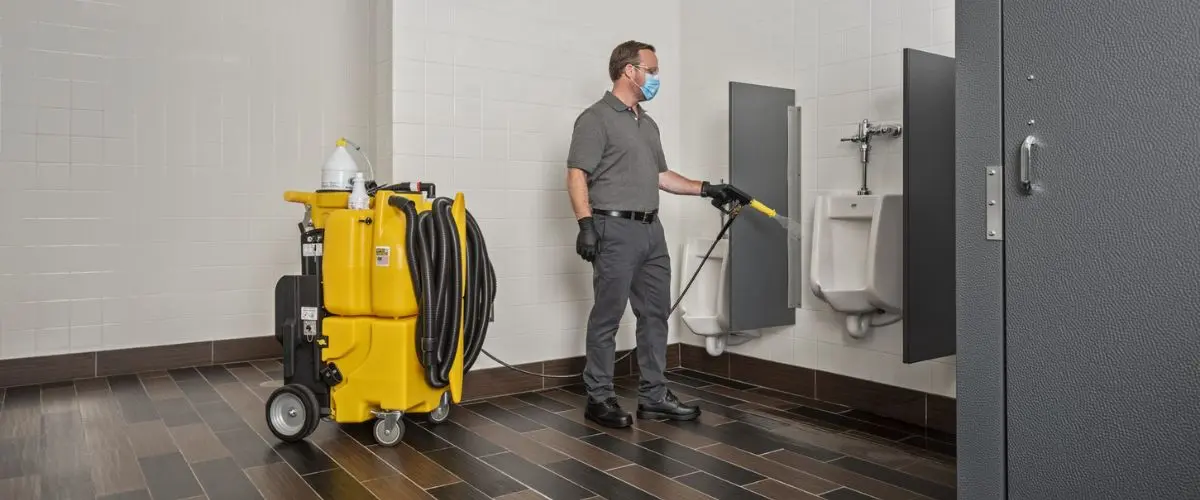
For the most effective cleaning Randolph recommends No-Touch Cleaning machines. This technology combines cleaning chemistry, mechanical energy, and good old gravity to capture and remove dangerous pathogens from restroom touchpoints and floors.
The No-Touch Cleaning Process
The process starts by spraying cleaning chemistry, containing surfactants, onto every restroom surface. Surfactants have two ends, one that loves water (hydrophilic) and another that hates it (hydrophobic). Add them to water and surfactants form into micelles, tiny spheres with the hydrophilic end facing out and the hydrophobic end tucked safely tucked inside.
Soils and pathogens are also hydrophobic. Once sprayed with cleaning chemistry, the particles lift off surfaces, move towards the middle of the micelle, and stay happily trapped inside.
After capturing dirt with chemistry, workers turn on the No-Touch Cleaning machine’s high-pressure rinse to blast the solution off surfaces and on to the floor. This mechanical energy takes the place of scrubbing and is powerful enough to remove soils from cracks, crevasses, and hard-to-reach areas on its own. This means cleaners do not need to bend, twist, or hunch. The mechanical energy is so powerful that even soils deeply embedded in grout are blasted free.
Working from high to low, cleaning staff use gravity to move soils and pathogens, now trapped in their soapy micelle prisons, from surfaces and touchpoints to the floor. The dirty solution is then sucked up by the No-Touch machine’s powerful vacuum.
Soils, including those dangerous pathogens, are removed from touchpoints, reducing the risk of transferring illness via hand contact. They are also removed from the floor, cutting the opportunity to track dirt and pathogens through the rest of the facility. The restroom is set to neutral. Because No-Touch Cleaning machines work fast, staff can quickly re-clean the restroom several times a day.
What happens in the restroom most definitely does not stay in the restroom. If infection prevention is on your mind, explore our tips for an odor-free restroom with tools, chemistry, and options from Kaivac.
Frequently Asked Questions: Infection Prevention and Restroom Floors
Why is the restroom floor considered the germiest surface, more than touchpoints like flushers and faucets? Research has identified genetic traces of 77,000 distinct types of bacteria and viruses in public restrooms, with fecal bacteria, influenza, E. coli, MRSA, salmonella, and norovirus among the most prevalent. Floors accumulate pathogens from toilet plumes, tracked-in soil, and grout, yet are cleaned less rigorously than touchpoints because they aren't considered "high-touch."
How do restroom pathogens spread beyond the restroom itself? People do more than use the toilet in restrooms — a Bradley Corporation survey found many check their appearance, use their phones, or set purses on the floor, all of which increase contact with contaminated surfaces. Research also shows bacteria hitch a ride on the exterior of shoes and transfer to flooring throughout a facility.
How does Kaivac's No-Touch Cleaning process actually remove restroom pathogens? Cleaning chemistry containing surfactants is sprayed on every surface, forming micelles that trap soils and pathogens. A built-in high-pressure rinse then blasts the solution — including grout-embedded soil — down to the floor, where a powerful vacuum removes it completely, working from high touchpoints down to the floor using gravity.
What did Kaivac's Allen Randolph say determines restroom infection risk? Randolph, Kaivac's vice president of business development, explains that "risk is a mix of pathogen load and exposure," and that effective, frequent cleaning reduces that pathogen load and lowers overall risk — something No-Touch Cleaning's speed makes practical to do multiple times a day.
Recommended Kaivac Solutions for Restroom Infection Prevention
For facilities focused on reducing restroom pathogen load, these Kaivac products directly address the risks covered in this article:
- Kaivac No-Touch Cleaning® System — the surfactant-spray-and-vacuum process described in this article for removing pathogens from touchpoints and floors alike.
- KaiVac 1750 — Kaivac's most popular No-Touch system, a solid default for most facility restrooms.
- KaiBlooey™ Restroom Cleaner — mild-acid formula suited for the urine-laden grout buildup this article identifies as a floor-level bacteria reservoir.
Related Posts

Introducing: See the Difference in 60 – A No-Cost Pilot Program for School Districts
Are you curious about what a
Read more
Cherokee County School District Takes Cleaning into Their Own Hands With Kaivac
Each of the district’s six high schools maintained their restrooms with a No-Touch Cleaning system from Kaivac.
Read more