
Cleaning Public Toilets: COVID-19 Edition
Executive Summary
COVID-19 added an extra layer of risk to already-established public restroom hazards, since restrooms are typically small, poorly ventilated, touch-point-heavy, and subject to toilet plumes that can aerosolize particles with each flush. Industry standard restroom cleaning takes about 3 minutes per fixture with traditional tools, but pandemic-era protocols — like McDonald's every-30-minute pledge — required far more frequent, thorough cleaning. Kaivac's No-Touch Cleaning® system cuts fixture cleaning time to about 1 minute while never requiring workers to touch a contaminated surface, making enhanced cleaning schedules more achievable.
Cleaning public toilets remains one of the most important jobs for maintenance workers. There’s plenty of research about the benefits, both real and perceived, of a clean, fresh-smelling public bathroom. Past studies show that unpleasant restroom experiences creates negative perceptions and a potential loss of customers and sales. And bathroom dangers, like contracting streptococcus, staphylococcus, E. coli and hepatitis A, present real public health risks.
Now add the threat of contracting COVID-19 to the mix and cleaning public toilets has never been more important to human health and economic stability.
Here’s what to consider when looking at your restroom cleaning schedule in the age of Coronavirus.
COVID-19 and Public Restrooms: What are the Risks?
Research and findings change constantly but, according to the CDC, the virus spreads mainly by person-to-person contact. The CDC also says it may be possible to get COVID-19 by touching a surface or object that has the virus on it and then touching their own mouth, nose or eyes. Additionally, mounting evidence suggests that the virus may spread by aerosols, tiny droplets that waft through the air and accumulate over time.
So how risky is it to use a public toilet? Microbiologist Ali Nouri, president of the Federation of American Scientists, summed it up in a CNN article, “They’re not great,” he says. “If you don’t have to use a public restroom, don’t.”
But in the same breath Nouri realizes that this is not really practical advice. “Sometimes when you gotta go, you gotta go,’ he says before breaking down the risks.
Risks of Public Restrooms
- Small spaces: This makes it hard to practice social distancing.
- Poorly ventilated: This means the virus could linger in the air.
- Many touch points: Handles, taps and flushers present hazards.
- Toilet plumes: Tiny microbes can become airborne after each flush and COVID-19 has been found in fecal matter. It remains unclear if these particles are infectious, but still…. eww!
COVID-19 and the Public Restroom: Are Any Even Open?
Because of the uncertainty around infection and the public restroom, some organizations choose to opt-out and close their facilities outright, much to the dismay of road-trippers and parents with small kids. Many fast food outlets moved to a drive-through only model and shuttered their restrooms. Gas stations, another dependable place for a road trip rest stop, have also started closing their restrooms.
And monitor your liquid intake carefully if you’re looking to go thrift shopping. Goodwill Industries of Northwest North Carolina writes that they are “reducing store hours to allow more time for cleaning,” which includes wiping down all high-touch surfaces regularly throughout the day. But the strategy doesn’t include the restroom. “As another precaution bathrooms, break rooms, and water fountains are temporarily closed to the public,” according to their website.
Cleaning Public Toilets: COVID-19 Edition
No matter what phase of reopening an area is in, public restrooms, especially those in essential businesses like grocery stores, will require attention…and lots of it. McDonald’s famously pledged to clean bathrooms every 30 minutes in their “Dine-In Reopening Playbook” distributed to franchisees.
That 30-minute timeline may not be appropriate for every business. Managers must take other factors into account like frequency of use, soil loads and disinfection protocols. But no matter the circumstance, expect to clean more often and more thoroughly than before. That means dedicating staff time to the task and providing the training and tools to get the job done safely and correctly.
That extra time will be important. Industry standards say it takes about three minutes to clean any given restroom fixture be it toilet, urinal or sink. But that doesn’t include hitting all of the important touch points, or the floor which should be considered a touch point as well. And disinfection requires a product be allowed to dwell to work adding extra time to the task.
Cleaning Equipment Upgrades
Consider upgrading your cleaning equipment to make this task easier, safer and faster. Mops, buckets, and rags are slow, cumbersome, and require cleaning staff to get down on their hands and knees to touch every surface. Even worse, they don’t fully remove dirt, bio-pollutants and other soils.
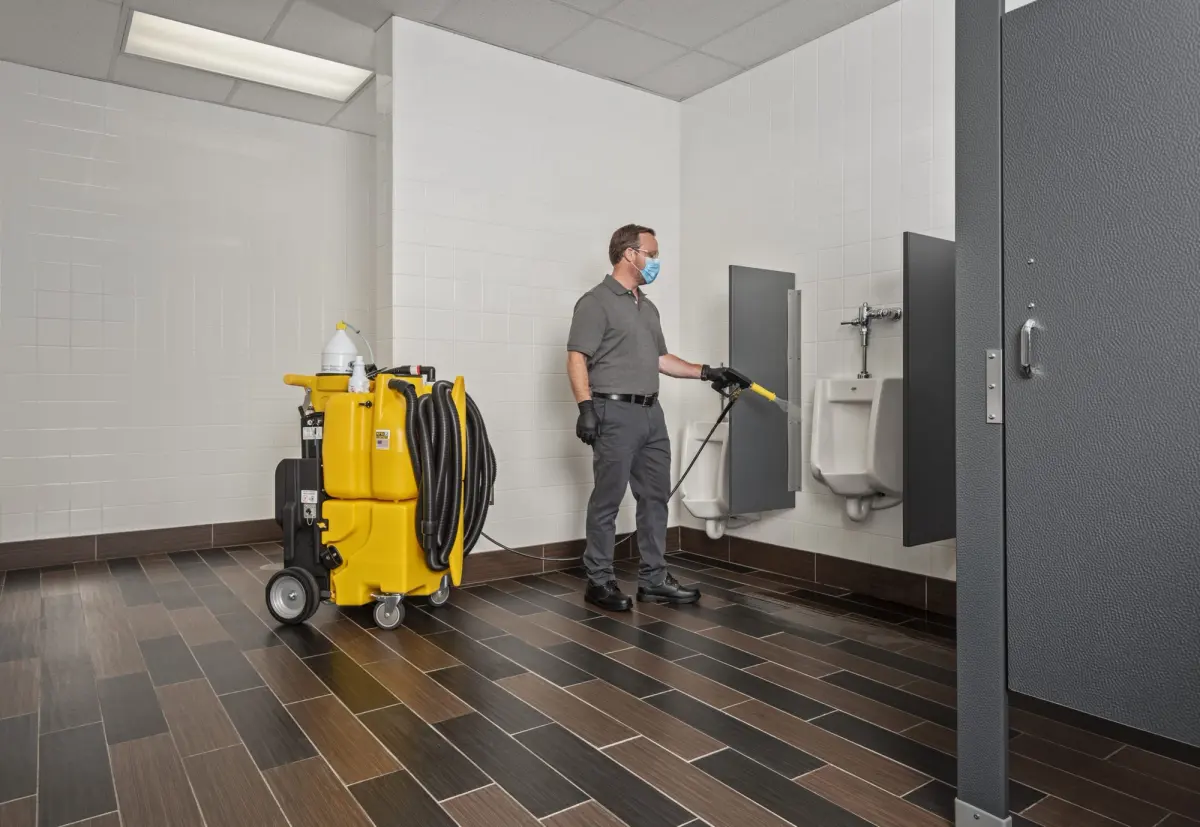
Try a Kaivac No-Touch Cleaning system instead. This innovative spray-and-vac system removes soils from fixtures, floors and walls in one step, leaving surfaces dry and ready to use. Cleaning takes as little as one minute per fixture and workers never have to touch a dirty surface.
For irregular touch points like soap dispensers, light switches, and door handles, try the Smart Towel. With eight numbered quadrants, staff can always use a fresh section, eliminating the possibility of cross contamination.
Frequently Asked Questions: Cleaning Public Toilets During COVID-19
What makes public restrooms especially risky during a disease outbreak like COVID-19? Public restrooms are typically small (making social distancing hard), poorly ventilated (letting airborne particles linger), full of shared touch points like handles and flushers, and subject to toilet plumes — the aerosolized droplets that can become airborne with each flush.
How often should public restrooms be cleaned during a health crisis? There's no single answer, but McDonald's pledged to clean bathrooms every 30 minutes in its pandemic-era reopening playbook. The right frequency depends on factors like how often a restroom is used, typical soil loads, and the facility's disinfection protocols.
How long does it typically take to clean a restroom fixture, and can that be sped up? Industry standards say it takes about three minutes to clean a single restroom fixture with traditional tools, not counting touch points or the floor. Kaivac's No-Touch Cleaning system cuts that to about one minute per fixture by removing soils from fixtures, floors, and walls in a single step.
Why are mops a poor choice for disinfecting a restroom during a disease outbreak? Mops require staff to get down on their hands and knees near contaminated surfaces, and they don't fully remove dirt and bio-pollutants — they just spread them around. A no-touch spray-and-vacuum system removes soils directly instead, without workers ever touching a dirty surface.
Recommended Kaivac Solutions for COVID-Era Restroom Cleaning
For facilities looking to meet enhanced pandemic-era cleaning schedules, these Kaivac products directly address the challenges covered in this article:
- Kaivac No-Touch Cleaning® System — the spray-and-vac tool for faster, touch-free fixture cleaning referenced throughout this article.
- KaiVac 1750 — Kaivac's most popular No-Touch system, a solid default for most facility restrooms. Step up to the KaiVac 2750 for high-volume restrooms, or down to the KaiVac 1250 for smaller ones.
- KaiBosh™ Disinfectant — hospital-grade disinfectant suited for the enhanced disinfection protocols this article discusses.
No doubt, battling COVID-19 requires an enhanced restroom cleaning schedule, but it doesn’t have to stress your staff. Discover more ways Kaivac can help with your public restroom cleaning challenges.
Related Posts

Introducing: See the Difference in 60 – A No-Cost Pilot Program for School Districts
Are you curious about what a
Read more
Cherokee County School District Takes Cleaning into Their Own Hands With Kaivac
Each of the district’s six high schools maintained their restrooms with a No-Touch Cleaning system from Kaivac.
Read more