
How No-Touch Restroom Cleaning Machines Protect Everyone's Health
Executive Summary
Restroom cleaning exposes custodians to 77,000 distinct types of bacteria and viruses, plus slip-and-fall, repetitive-motion, and chemical hazards. No-Touch restroom cleaning machines reduce that risk: auto-metered chemicals protect workers from overexposure, a pressure rinse flushes soils from grout and tight places, and vacuuming leaves surfaces dry—eliminating slip hazards. The result is a safer job for the nation's 2.4 million custodial workers and hygienically clean restrooms for everyone else.
Restroom cleaning is hazardous in the best of times. Not only do maintenance crews suffer musculoskeletal disorders from the heavy lifting, prolonged standing and regular bending the job demands, they also risk coming into contact with 77,000 distinct types of bacteria and viruses, according to a study published in Applied and Environmental Microbiology. On a regular day, these nasties include fecal bacteria, streptococcus, E. coli, influenza, hepatitis, MRSA and salmonella. Now we've added the COVID-19 to the list. But luckily, there's a bathroom cleaning machine to meet the challenge.
The Threat Has Always Been Real
Don't kid yourself. The nation's estimated 2.4 million custodial workers never had it easy. The work is physically demanding, low paying and dangerous. Yes, dangerous. For proof, check out this story written by a custodian who caught hepatitis A while cleaning a daycare restroom.
Maintenance crews also face threats like:
- Slip, trip and fall injuries
- Repetitive motion injuries
- Chemical hazards from cleaning products
Making a Stressful Job Even Harder
While the bulk of the nation was sheltering in place, essential custodial workers were still out there deep cleaning grocery stores, warehouses, hospitals and more. They were sometimes working longer hours and using stronger cleaning chemicals without training or appropriate personal protection equipment, often with horrible results.
'They just said, 'Hey guys, corona's scary, use this," according to Ismaham Ali, an office cleaner in Seattle. "This" turned out to be Virex II 256, a powerful disinfectant Ali never used before or trained on. "They didn't say be careful or anything,' she reports in an article published on Arkansasonline. Within an hour, her eyes and skin began to burn and she developed a rash. Thankfully, training was given and appropriate protective gear was distributed to Ali and her co-workers shortly after.
An upsetting story for sure, but oversights happen in a fast-changing situation.
The Wrong Tools Make Restroom Cleaning Worse
We already know that what happens in the restroom definitely doesn't stay in the restroom. Studies show that these pollutants eventually make their way throughout the entire facility if not removed at the source. Old fashioned tools like mops, buckets and rags are not designed to fully remove dirt, soils and pathogens so using them amplifies this risk of cross contamination.
Using them also requires the cleaning staff to touch a variety of dirty surfaces, including the tools themselves, further increasing risk.
Mops, buckets and rags also contribute to the other health hazards cleaning staff face every day. Wet mops are heavy and unwieldy, so using them puts stress on workers joints. Wiping surfaces by hand requires bending, reaching and crawling, another known stressor. Plus, they leave surfaces wet, increasing slip, trip and fall hazards.
Common Questions About No-Touch Cleaning and Health
What health hazards do custodians face when cleaning restrooms?
Custodians face three main threats: contact with 77,000 distinct types of bacteria and viruses (including fecal bacteria, E. coli, hepatitis, MRSA and salmonella), slip-trip-and-fall and repetitive-motion injuries from heavy wet mops and bending, and chemical hazards from cleaning products.
How does no-touch cleaning protect cleaning workers?
No-touch machines protect workers three ways: an automatic metering system correctly dilutes chemicals to prevent overexposure, an indoor pressure washer flushes soils from grout and tight places so workers don't have to bend or crawl, and vacuuming leaves surfaces dry to eliminate slip-and-fall hazards.
Why do mops and buckets increase cross-contamination risk?
Mops, buckets and rags are not designed to fully remove dirt, soils and pathogens, so they amplify the risk of cross-contamination. Using them requires staff to touch dirty surfaces, including the tools themselves, and wet mops stress workers' joints while leaving floors wet and slippery.
No-Touch Restroom Cleaning Reduces Risk
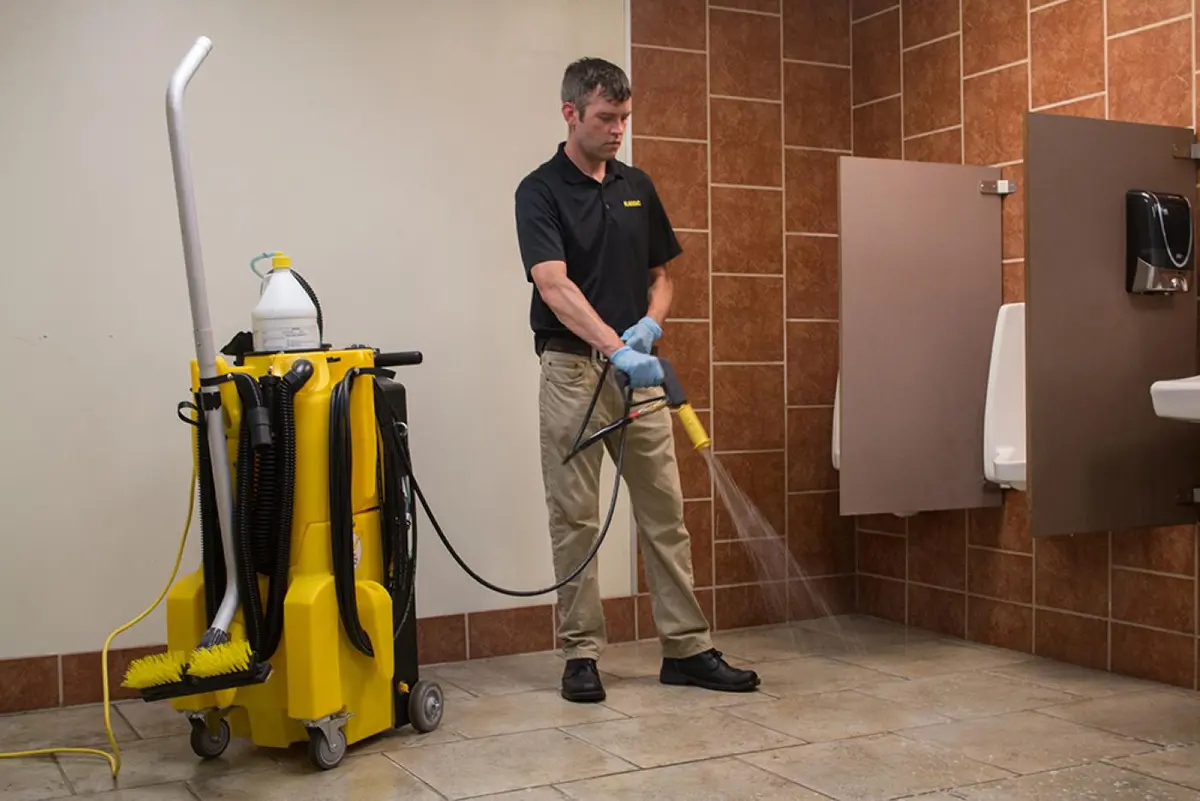
There are tools that minimize these risks and leave surfaces cleaner and more hygienic. Spray-and-Vac technologies allow workers to finish cleaning jobs faster, more completely and much more safely.
Plus, there's an important added bonus; workers never have to touch surfaces.
Custodians simply spray cleaning solution on to fixtures and floors with the machine's a low-pressure fan spray. An automatic metering system ensures the cleaning product is correctly diluted, insulating workers from unnecessary chemical exposure. Then surfaces are rinsed with fresh water using an indoor pressure washer. This pressure washer is powerful enough to flush soils out of grout lines and tight places, eliminating the need to bend, reach and crawl around touching dirty surfaces.
Finally, the rinse water and all of the dirt, soils and bio-pollutants are vacuumed up. This step leaves surfaces dry, eliminating slip and fall hazards. They are also virtually soil and germ free.
Restrooms maintained with this superior process protects everyone. Custodians can work quickly with less strain, effort or risk and the public benefits from hygienically clean spaces. Click here to learn more about No-Touch Cleaning.
Recommended Kaivac Systems for Health-Protective Restroom Cleaning
- KaiVac 1250 — Compact system for smaller restrooms in offices, clinics, and restaurants, delivering the same health-protective spray-rinse-vacuum process.
- KaiVac 1750 No-Touch Cleaning System — Kaivac's most popular mid-size system, right-sized for most commercial restrooms.
- KaiVac 2750 No-Touch Cleaning System — Largest capacity system for grocery stores, warehouses, stadiums, and other high-volume facilities.
- KaiBosh Disinfectant — Hospital-grade disinfectant for the bacteria, viruses, and pathogens that threaten custodial workers and the public.
Kaivac Staff
Related Posts

Introducing: See the Difference in 60 – A No-Cost Pilot Program for School Districts
Are you curious about what a
Read more
Cherokee County School District Takes Cleaning into Their Own Hands With Kaivac
Each of the district’s six high schools maintained their restrooms with a No-Touch Cleaning system from Kaivac.
Read more